

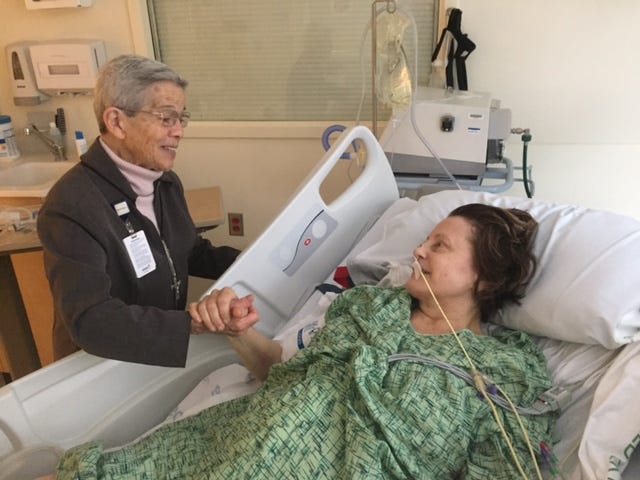
Sharp Memorial Hospital chaplain visit.
When I was in the hospital for six weeks recovering from a near-fatal car crash in 2017, I used mindfulness to help me stay positive during very difficult and painful situations.
It began after my fifth surgery in 15 days when I heard a voice that said, “You get to choose how you experience these injuries. What will you choose?”
This was not the voice of my usual intuition. This was a different voice that I believe was my spiritual guide.
I thought, I don’t want to be a victim of this wreck. I’ll follow the high road. I wanted to manage my mind instead of it managing me.
I accepted the reality of the situation.
I was in the hospital because I’d been in a near-fatal car wreck in the Baja desert.
I had to depend on my caregivers for everything.
They were trying to save my life.
John (husband) was my lifeline back to my life back home, keeping me informed.
My job was to heal and recover so I could get back to living my life.
About three weeks into my hospital stay, once things had settled down and I was recovering from the surgeries and alone in my hospital room, I started crying. I wasn’t pitying myself for what had happened.
I felt sad that my body had to go through all of this. The tears just flowed.
At that moment, my trauma surgeon, Dr. Kill, walked into my room. His mouth opened. He was visibly taken aback that I was crying, and I could tell it made him uncomfortable.
“What’s wrong?” he asked.
“I’m feeling sad that all of this has happened,” I said.
He said he’d put in an order for the nurse to have a wheelchair brought to my room so John could take me to the atrium, outside the hospital room.
It was the first time I could be reflective and feel these emotions. Until then, I was literally trying to survive, getting through one surgery to the next, to the next.
I felt compassion for myself. Taking the high road didn’t mean I couldn't feel my emotions. It simply meant my attitude would determine how I recovered.
One year after the accident, we drove down to San Diego with our Airstream to visit Dr. Kill and all my caregivers at Sharp Memorial Hospital.
We visited Dr. Kill in the surgical-floor family lounge.
“Most people just want to get through this and get on with their lives,” Dr. Kill said. “You seemed to be reflective and accepting of what was happening.”
I knew not to resist what was happening in my outer world, because it was happening.
What is self-compassion?
Self-compassion means being kind to yourself when life isn’t going the way you want.
When you notice your struggles and respond with compassion, kindness, and support in difficult times, your life will begin to change.
Kristin Neff, PhD, has researched self-compassion for decades, and her research shows that giving yourself a break from judgment and learning to accept your imperfections is linked to better health.
Self-compassionate people tend to be happier and have a more optimistic outlook.
Three components need to be in place:
Mindfulness — the foundation of self-compassion. It teaches us how to respond to stress with awareness of what is happening in the present moment. It’s our ability to be with ourselves with an open, non-judgmental attitude toward what’s arising.
Being kind to ourselves — this is simply treating yourself with loving care and concern as you would show to a good friend. We know how to do this for others, but we aren’t used to doing it for ourselves.
Connectedness — remember that we’re all imperfect. We’re all in this together. I’m imperfect, and I know we all share this human condition.
Self-compassion isn’t self-indulgence
Dr. Neff advises against confusing self-compassion with self-indulgence, one of the biggest reasons people aren’t more self-compassionate.
People think self-criticism keeps them in line, but it doesn’t. I had a client who kept telling me that his inner critic kept him on task and motivated to do hard work. He believed that if he were compassionate with himself, he wouldn’t be as motivated. But I encouraged him to practice and see how it felt.
In a 2012 study, researchers found that people who were kind to themselves after a failure or mistake were more motivated to make amends, and students who failed a test studied longer for the next one.
The researchers concluded that, “somewhat paradoxically,” accepting your failures may make you more motivated to improve.
I can attest to this. For the past two years, I’ve been reaching out to people I’ve hurt to repair the hurt I caused growing up. Although it’s hard to hear how I hurt them, it motivates me to be a better person and a better friend.
Research shows that self-compassion helps people feel more socially connected, increases life satisfaction and happiness, and reduces depression, anxiety, and stress.
Being more caring to yourself makes you more compassionate with others.
People who practice self-compassion are more able to cope with life challenges such as divorce, chronic pain, or raising special needs children.
Self-compassion is a superpower. We often use it only to comfort others, but we need to start using it for ourselves.
Practice
Think of a friend who needed support recently. How did you respond to them when they needed your support?
Now think of when you needed support recently. Then respond to yourself with the same kindness, goodwill, and an open heart.
This is a good antidote to your own inner critic, whose voice can be hurtful.
Fostering self-compassion requires courage. It calls for mindful commitment. It’s a way of being in relationship with ourselves that lays the foundation for resilience when facing life’s challenges.
Next week: The 20-Second Practice That Calms Your Stress Response.
XO,
Sherold
Resources: The Center for Mindful Self-Compassion: www.centerformsc.org
Related post: Inner Critic
Source: Breines & Chen (2012), Self-Compassion Increases Self-Improvement Motivation
High Road to Healing with Sherold Barr is a reader-supported publication. To receive new posts and support my work, consider subscribing for free or paid access. NOTE: Paid subscribers are invited to a Live Zoom Gathering each month on a topic of interest. Join our High Road Community!
Resources: The Center for Mindful Self-Compassion: www.centerformsc.org
Related post: Inner Critic